
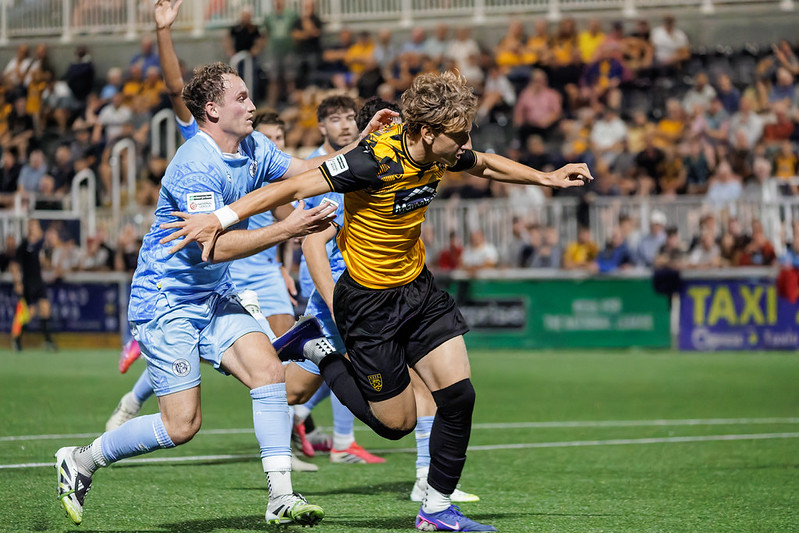
Stones Live’s Jon Crowther gives his thoughts on Tuesday night’s game.
Pictures by Helen Cooper.
The game started brightly and was end-to-end for the first 20 or 25 minutes. Folkestone were offering just as much of a threat as Maidstone, particularly down their left, where Jamie Fielding and Dan Quick were causing problems. Quick was playing in a more advanced position, with Fielding operating more as the full-back, and they were finding plenty of space.
For Maidstone, there was already a pattern developing. A lot of our attacking play started with George Fowler at full-back. He was either starting attacks from deep, carrying the ball forward or overlapping and putting crosses into the box.
Leo Hamblin has improved enormously over the last season or so. He seems to have developed the right temperament now and looks a very good defender, but he’s also a really useful outlet going forward, with an excellent range of passing.
Further forward, Tom Leahy and Leone Gravata were playing in advanced wide positions and both were effective. Leahy particularly impressed me when he stayed wide, while Gravata was getting crosses into the box from the left, and then there was Riley Court.
It seemed that wherever the ball was, Court was an option. Whether we were starting an attack or finishing one, he always seemed to be involved. I’ve not seen a player like that at this level for a very long time. Even in the pre-match warm-up he looked the quickest player in some of the sprint exercises.
I don’t know how long we’ll manage to hold on to him, but hopefully somewhere in his contract there is some compensation clause for when he eventually moves on, because I think it’s only a matter of time. In the meantime, we should just enjoy watching him play.

Riley Court at full pelt. Picture by Helen Cooper.
As the first half went on, Maidstone started to establish more of a pattern and began to dominate possession. Folkestone were still dangerous, but Maidstone were increasingly controlling the game, although Lenny Holden also made an important save late in the half. For a big guy, he got down very well and very quickly for a low save. It was an impressive bit of goalkeeping.
There was also an interesting battle between Taylor Foran and Joe Pigott. It was a very physical contest between the two of them and, over the course of the 90 minutes, I’d say Foran came out on top. Pigott showed some lovely touches and his experience was obvious, but he didn’t influence the game quite as much as I expected him to and he was eventually substituted in the second half.
Going into the second half, it looked to me as though Folkestone had made a small tactical adjustment. Jamie Fielding appeared to be holding a little deeper rather than pushing forward as much, which meant there was less space for Maidstone’s wide players to run into and it seemed to cut out some of the threat we’d been creating.
Folkestone then took the lead. One of their attacks broke down and the ball was initially cleared by a Maidstone defender. It came out to Adam Lovatt, who had just come on for Harvey Kedwell, son of former Maidstone player Danny Kedwell. Lovatt absolutely hammered it from the edge of the box and the ball went through a crowd of players before beating Lenny Holden. Having seen the replay, it was actually fairly close to Lenny, so perhaps he might think he could have done better, but there was an awful lot of power on the shot.
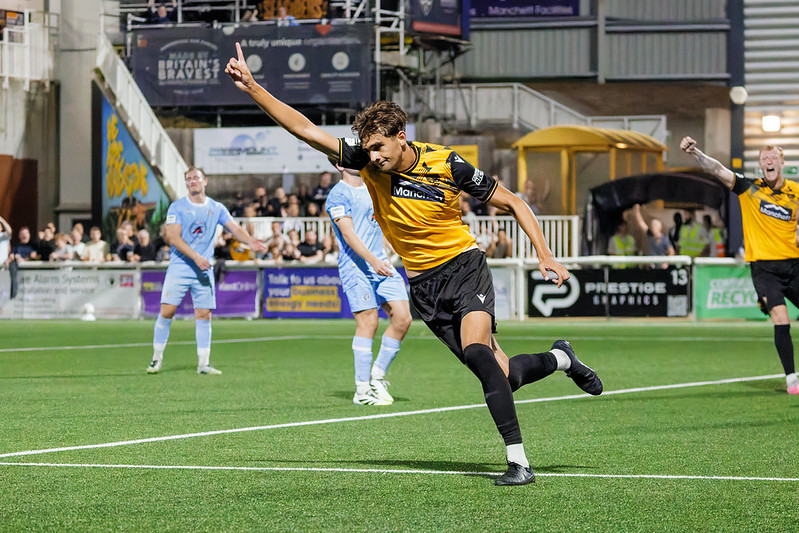
Frankie Hvid, unsure if he’s scored the equaliser and celebrating anyway. Picture by Helen Cooper.
Maidstone didn’t panic, though, and continued to play in much the same way. Within a few minutes we were attacking again and a cross-cum-shot from the impressive new centre-back Frankie Hvid came across the penalty area. I don’t think it was actually going in, but all it needed was the merest of touches from Ken Charles, who had been relatively quiet up to that point.
There were a couple of other moments in the second half that caught my attention, particularly because they were the first time I’d seen the new interpretation of the rules around tactical delays involving injuries.
At one point a Folkestone player went down injured during a Maidstone attack. The Folkestone bench then called their players over for refreshments and a hydration break and the Maidstone players followed suit.
The referee clearly judged that the injury had effectively been used as a tactical opportunity to regroup and receive instructions. As a result, the injured player was required to stand off the pitch for a minute before being allowed back on.
I actually think this could eventually make a real difference to one of the darker arts of football — using injuries to deliberately slow the game down or allow a team to reorganise. In this case it happened right in the middle of a Maidstone attack and Folkestone were clearly benefiting from the stoppage.
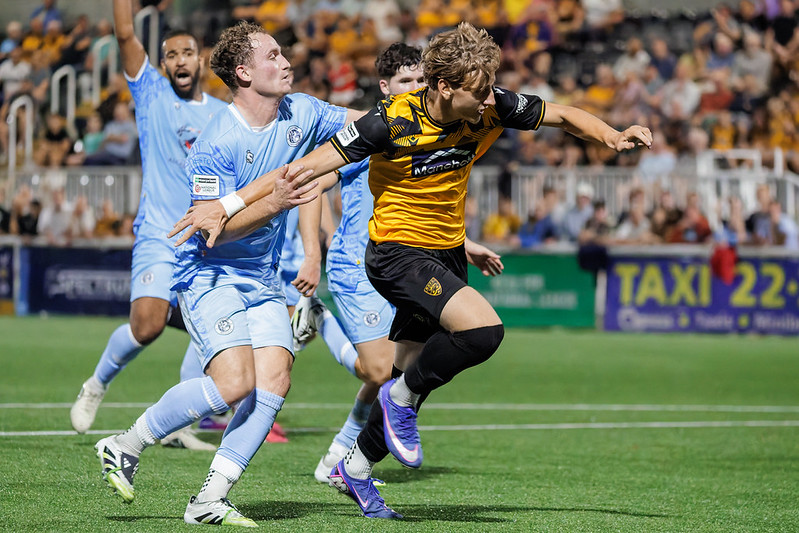
“Have we got contact?” The stoppage time challenge on Mark Boruk. Picture by Helen Cooper.
Something similar happened shortly afterwards when Folkestone made a substitution but the player coming off didn’t leave the pitch quickly enough. The referee again decided that this had gone a little too far and the replacement was made to wait before being allowed onto the pitch.
I thought the referee actually had a good game. There had been quite a bit of criticism of him, but I couldn’t really understand it, other than perhaps supporters being frustrated when decisions don’t go their way. The couple of penalty appeals were, in my view, correctly dealt with. He generally allowed the game to flow and, although it was feisty at times, it never really threatened to boil over considering it was a local derby.
Both teams wanted to play football, and that made for a very good game. One thing that became increasingly obvious in the final quarter was that Folkestone were tiring. I don’t know exactly what their training regime is since they’ve come up — whether they’re effectively full-time, or what their daytime training arrangements are — but I understand they’re training two evenings a week, while Maidstone are training three days a week.
If that’s correct, I thought it showed towards the end. Folkestone struggled when they came under pressure to get the ball out or find an outlet. Maidstone were able to press them and keep the pressure on.
Their two right-sided players, Fielding and Quick, had been particularly effective in the first half, but their influence diminished as the game went on.
Kevin Lokko, another former Maidstone player, was very solid at the back for Folkestone, while goalkeeper Ted Collins kept them in the game on several occasions. I lost count of the number of saves he made.
From the Maidstone perspective, George Fowler was particularly impressive. This was my first game of the season, and it struck me that Fowler is almost carrying on the message, style and culture that has been built into this side over several years. I honestly can’t remember seeing him have a bad game. He’s now playing at full-back and in a more advanced position, and he was very effective.
Taylor Foran looked like an old-school centre-back — strong, competitive and effective. Frankie Hvid was equally impressive. His tackle on Joe Pigott in the second half was excellent, and he was also involved in the attacking side of the game, providing the assist for the goal.
Tom Leahy was very effective when he stayed out wide, although less so when he moved inside.
And then, inevitably, there was Riley Court. I probably mentioned his name too many times during the commentary, but that’s because everything seemed to go through him. Overall, I thought Maidstone looked very good going forward. In fact, it was probably the best attacking performance I’ve seen from us at Gallagher for a long time.
The obvious caveat is that Folkestone played in a way that allowed us to do that. They were attacking themselves and leaving spaces, so I’m not sure we’d get quite as many opportunities against some of the stronger, more defensively organised teams we’ll face this season.
But you can only play what’s in front of you, and Maidstone took full advantage.
The final few minutes produced one more memorable moment. In the 97th minute, a Folkestone attack broke down in our penalty area. Riley Court picked the ball up and then went on a run that took him almost the full length of the pitch. It reminded me of Maradona in the 1986 World Cup.
He eventually played the ball through to substitute Mark Boruk, who went down under a challenge in the Folkestone penalty area. It looked like a penalty at first, although my instinct at the time was that the contact wasn’t clear enough. Having now seen the replay, I think the referee got that one right as well.
